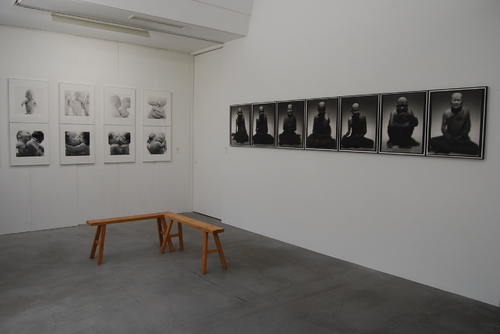
In this exhibition we bring together two series. Manit's “Masters” are images of idolatrous
statues of monks. They appear to be real, yet are made from resin. They may purport to
represent monks that have reached nirvana, yet they are oered for sale by Buddhist shops,
oen for the prot of modern day monks and temples.
Tim's “Still Lives” are images of babies who were never born. They died before they had a
chance to experience the world. And so they died perfect. Is that not as close as any person
can get to attain nirvana?


“Masters” by Manit Srinawichpoom
One day Manit Srinawichpoom noticed a strange small statue for sale in a shop selling
Buddhist items. It was a lifelike model of a Buddhist master made out of resin. ese objects
are sold at high prices to people who wish to pray to a particular “master”.
Manit decided to seek out more of these miniature statues and to photograph them. Manit
had kept a stock of Polaroid negatives which he used to produce these works. By changing
the focus and printing in greater than actual size, we get a feeling that these masters are now
alive in these photographs.
e artist is making another statement here. In true Buddhism only the lord Buddha himself
is to be venerated, not any person, alive or dead. But in today's Thailand the Buddhist
church has complacent and materialistic along with the monks, and cult of personality is
encouraged, contrary to the instructions of the true masters.

“Still Lives” by Tim Porter
In 1988 Tim Porter obtained permission to make these photographic studies of unborn
foetuses stored in the Sirirai Hospital Museum in Bangkok.
He produced these exquisite pictures. The unborn foetuses, many of which are conjoined,
appear to be oating, and traces of all surroundings, the glass jars and the storage solutions,
have disappeared.

Artist Profile

Tim Porter

Tim Porter is a Canadian photographer, painter and filmmaker, known for his highly formalist photographs that range from documentary and landscape images to abstract experimental works.

Born to Canadian parents in Washington, D.C., Porter studied literature and philosophy at the University of Virginia from 1964 to 1967 before moving to Montréal and taking up photography.

By 1970, he was living in Vancouver, where he became active in the photography community. In both representational street photography and abstract works, Porter began experimenting with radical composition and cropping, highly contrasting light and shadow and grainy texture.

In 1978, Porter made his first photography trip to Japan, where he explored the coexistence of traditional and contemporary cultures for the series Tokyo Archaeology (1978 –1980). In 1980, he secured a position as Tokyo Bureau Chief for the U.K.-based agency Camera Press, taking on documentary photo assignments.

Porter’s sustained interest in Japanese gardens resulted in a series of dark, meditative landscapes infused with a sense of the spiritual (2000 –2008). In Still Life (1988), he made a series of poignant, luminous photographs of stillborn conjoined twins that had been preserved in formaldehyde in a Bangkok anatomy museum. He also made a series of colour field photographs with Ether (1999), based on Polaroid photography. Porter has travelled and photographed extensively in Japan and other parts of Asia, as well as the South Pacific.

Porter’s work was first shown in the National Film Board of Canada’s group exhibition A Review of Contemporary Photography in Canada (1969) and the groundbreaking B.C. Almanac(h) - C.B. (1970), which was remounted at Vancouver’s Presentation House Gallery in 2015. His photographs have been exhibited nationally and internationally, in solo and group shows, and are held in both private and public collections. The National Gallery of Canada holds a large collection of Porter’s photographs, including works from his 1970s downtown Vancouver series and his Japanese garden series. — By Katherine Stauble ©National Gallery of Canada

Publications & Prints